

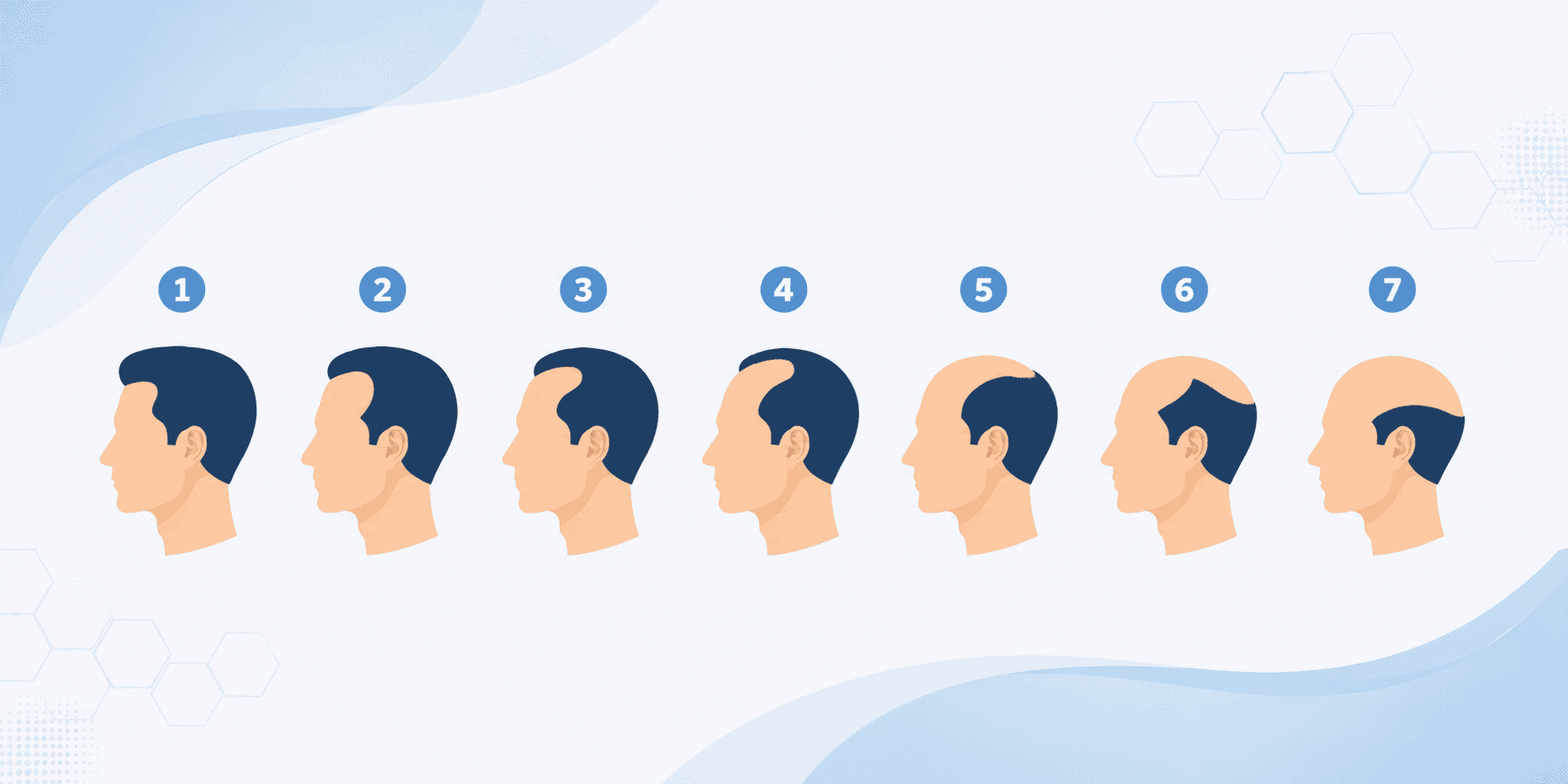
The Norwood Scale – also called the Hamilton-Norwood Scale – is a recognised system that helps hair restoration clinicians identify which phase of hair loss a patient has reached, as this rarely happens all at once and follows a general pattern.
Patients and practitioners need to determine the phase of hair loss they’re dealing with, as this indicates how far hair loss has progressed, which treatments will be most effective, and whether procedures like a hair transplant are likely to deliver good results.
For patients who may have noticed mild recession around their temples or more advanced thinning across the crown, looking at the Norwood Scale [1] can assist with taking action earlier and making informed treatment decisions.
Norwood Scale for Hair Loss: Key Takeaways
- The Norwood Scale is the most commonly used method to classify male pattern baldness and helps determine the stage and pattern of hair loss – noting that a separate scale is used for women. [2]
- Early-stage hair loss is more likely to respond well to non-invasive treatments like minoxidil and finasteride, whereas advanced hair loss may require a surgical intervention such as hair transplantation.
- While the scale standardises the stages of hair loss, factors like genetics, hormones, lifestyle and natural ageing can all influence male pattern baldness, where sensitivity to the DHT hormone plays a big role in how quickly follicles shrink.
What Is the Norwood Scale and How Is it Helpful?
This scale is a visual system developed in the 1950s by Dr James Hamilton and later expanded by Dr O’Tar Norwood in the 1970s – hence the two names. It measures the severity and progression of male androgenetic alopecia, or pattern hair loss.
It’s still widely used today by dermatologists and hair transplant surgeons, and categorises hair loss into seven stages, starting with minimal recession and progressing to extensive or total baldness.
Using the Norwood Scale is beneficial because male pattern hair loss typically follows a fairly predictable pattern, especially around the temples, crown and hairline. Tracking the place on the scale where a patient sits means professionals can recommend the most appropriate treatments, whether:
- An FUE hair transplant
- PRP or laser therapy
- Medical hair loss treatments
- Cosmetic approaches like scalp micropigmentation
In addition, when a patient knows their stage, they can continue tracking hair loss progression and have a better idea of how and when hair loss might continue in the future.
What Are the Seven Norwood Scale Stages of Hair Loss?
The scale starts at phase one, where hair loss is minimal or impossible to spot, and goes on to phase seven, at which point only a small strip of hair might remain:
| Norwood Stage | Typical Hair Loss | Common Treatments |
| 1: Initial or low-level hair loss | Little or no visible recession at the hairline, which remains youthful without significant thinning. | Monitoring and prevention |
| 2: A mature hairline | At this point, men might notice a slight recession around their temples, which isn’t necessarily balding but is considered a mature-looking hairline. This is the point in which you should consider hair loss treatments or a hair transplant consultation. | Medications like minoxidil and finasteride |
| 3: First signs of noticeable balding | Stage three is usually considered the first significant phase, in which the hairline becomes deeper at the temples, forming an M, U, or V shape. | Non-surgical treatments like PRP and medication, often alongside a hair transplant consultation |
| 4: Significant recession and thinning on the crown | Phase four means hair loss is more obvious, with a visible bald patch at the crown and deeper hair recession, though a strip of hair normally separates the front hairline from the crown. | Hair transplants become a potential solution |
| 5: Advanced hair loss | Areas of hair loss start to become larger, and often the remaining hair between the front and the crown thins. | Surgical hair restoration is likely the only way to correct balding |
| 5: Widespread balding | Now the strip of hair that separates the crown and temples will disappear or shrink further, with balding areas starting to merge. | More extensive transplant planning |
| 7: Severe hair loss | At the most advanced Norwood Scale stage, hair loss is significant, often with just a horseshoe-shaped band of hair that will continue to thin. | Transplants may not be viable depending on the number of healthy donor follicles remaining. |
Get a cost for your hair transplant
Looking for a consultation regarding the hair transplant cost? Book a free consultation with us today to see what we can do for you.
How Do Hair Restoration Experts Diagnose the Right Norwood Stage?
Practitioners need to perform a clinical exam to identify the stage on the scale where each male patient falls. This is why it’s important to have an in-person consultation before considering any hair loss treatment plans.
During this evaluation, a professional will examine factors like:
- The shape of the hairline
- Density of hair at the crown
- Speed of hair loss
- Family history of pattern hair loss
If there is the potential that hair loss isn’t due to androgenetic alopecia, but is related to something else, such as alopecia areata, nutritional deficiencies or thyroid disorders, a clinician may advise on additional testing or refer a patient to their GP.
KSL Clinic says, ‘One of the biggest mistakes we come across is when a patient has waited too long before seeking advice – because early intervention gives us more treatment options and better long-term outcomes.
Therefore, we’d recommend booking a consultation at the first point at which you have hair loss concerns, ensuring you can slow down the speed of balding or schedule a transplant, if you wish, while there is ample donor hair remaining.’
What Are the Most Common Misconceptions About the Norwood Scale?
A clinical scale can seem intimidating, and there are common concerns, such as assuming a mature hairline means a person will go completely bald or perceiving that men can’t be diagnosed in a later Norwood phase until they reach a certain age, both of which are untrue.
Instead, the scale shows hair restoration teams the current situation, and is a valuable tool that ensures practitioners have the information they need to customise hair restoration treatments to each individual.
Frequently Asked Questions
Which Norwood Scale Is Considered Bald?
Most people consider phases from five to seven to represent significant levels of hair loss, although visible thinning could start much earlier than this.
Can the Norwood Scale Predict Future Hair Loss?
Potentially, yes, because it can help clinicians to estimate how hair loss might progress, combined with information about a patient’s age, lifestyle and family history. However, it can’t state with certainty when, or if, hair loss will reach a specific phase.
Which Norwood Scale Is Considered Bald?
Most people consider phases from five to seven to represent significant levels of hair loss, although visible thinning could start much earlier than this.
Can the Norwood Scale Predict Future Hair Loss?
Potentially, yes, because it can help clinicians to estimate how hair loss might progress, combined with information about a patient’s age, lifestyle and family history. However, it can’t state with certainty when, or if, hair loss will reach a specific phase.