

1. Arriving at Your Preferred KSL Clinic Location for Your Consultation
Our practices are designed to provide a professional and welcoming setting. You can choose from clinics in accessible city centres with direct public transport connections, or those on the outskirts, where parking is easier.
When you arrive, you’ll be greeted, asked if you’d like any refreshments, and advised on where to wait for your consultation. If the practitioner is ready, you’ll be invited to head right in.

2. Discussing Your Hair Loss Concerns and the Outcomes You’d Like to See
We’ll begin with an informal discussion to gain a clear understanding of the aspects of your hair growth that you’re dissatisfied with and why. This might sound obvious, but we consult with patients with diverse concerns, including:
- General thinning across the scalp
- Areas of baldness or progressive hair loss
- Facial hair thinning and sparsity
- Eyebrow thinning and hair loss
This chat includes a discussion about when you first noticed signs of hair loss, as well as any patterns or lifestyle changes that may be contributing factors. We’ll also want to know if you’ve tried any hair restoration products or treatments thus far and if there’s a family history of hair loss.
Next, we’ll move on to what you’d love your hair, facial hair or eyebrows to look like post-treatment. It’s vital that we set realistic expectations and determine whether your desired results are feasible.
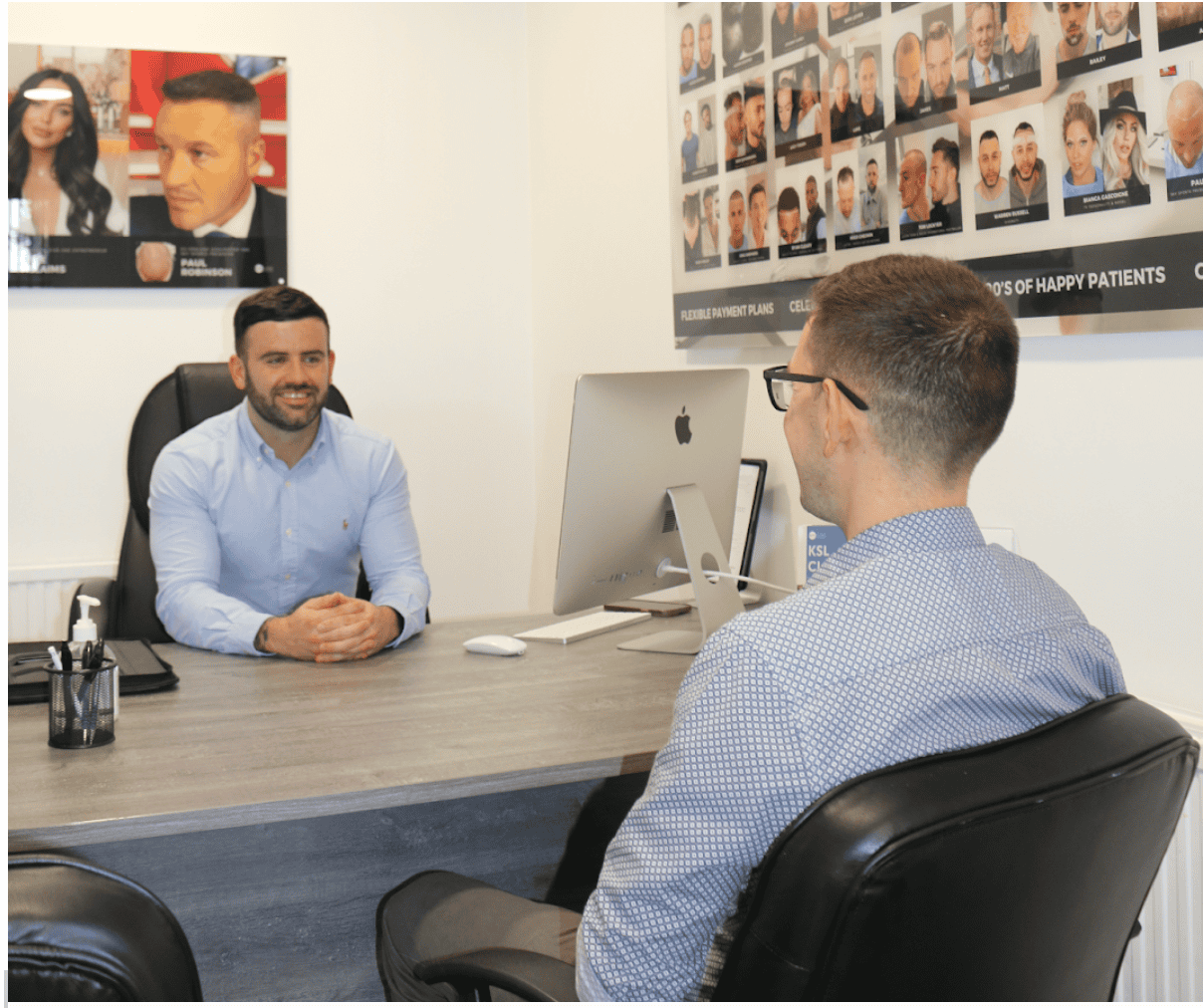
3. Assessing Your Scalp and Hair Health
When we’ve identified the specific hair loss concerns you have, one of our specialists will analyse your scalp and hair, often using microscopic equipment and taking photographs which help with bespoke hair restoration planning.
Understanding the exact nature and location of balding or thinning enables us to pinpoint:
- The severity of hair loss and how we’d grade this on the Norwood or Ludwig scales.
- The health and availability of donor hairs, and whether there are enough donor hairs to complete your required hair transplant.
- The suitability of varied treatments and therapies, from FUE hair transplantation to LED laser and PRP therapies.
Taking photos isn’t solely about planning the procedures we suggest, but enabling you to visualise the results we can deliver and comparing the outcomes throughout the recovery period.
4. Creating a Customised Plan of Action
Our approach is always bespoke to each patient, because there isn’t one treatment or therapy that will be ideal for all. That means we create personalised treatment plans based on our assessment of your hair loss and the interventions we believe have the best chance of success.
Treatment plans could include, for example:
- An FUE hair transplant procedure, offering walk-in/walk-out hair transplants under local anaesthetic for a precise, minimally invasive and permanent hair restoration solution.
- PRP therapy to activate dormant follicles and stimulate thicker, healthier hair growth.
- Medications to slow the pace of pattern hair loss and get this under control.
- Other non-surgical therapies, such as LED light therapy, which offer similar outcomes to PRP without the use of needles.
We’ll also incorporate specific details into your plan, such as the number of grafts required for a hair transplant, the anticipated timelines for seeing tangible results, and any follow-up hair rejuvenation therapies to support post-transplant recovery.