

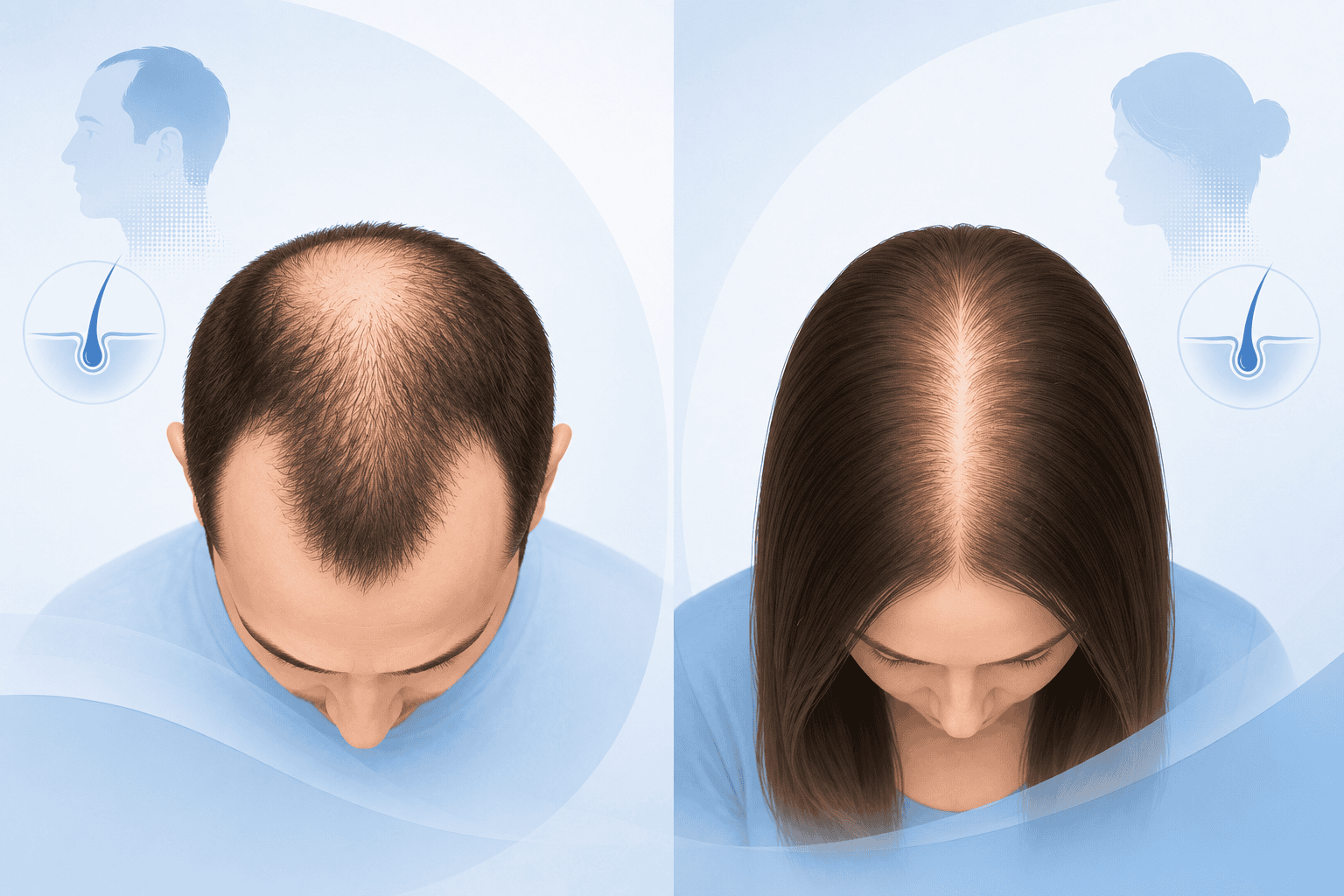
Androgenetic alopecia, more often called male or female pattern hair loss, is caused by genetics. It’s defined by the gradual thinning or loss of hair, and while there isn’t necessarily a permanent cure, there are many treatments available.
Some focus on slowing the rate of hair loss and protecting remaining follicles, whereas others restore hair density using interventions such as platelet-rich plasma therapy or a surgical hair transplant.
Anyone experiencing gradual thinning, a receding hairline, or a parting that keeps getting wider may want to understand the condition and take action early to choose an effective treatment plan that offers long-term results.
Androgenetic Alopecia: Key Takeaways
- Androgenetic alopecia is a common cause of hair loss and impacts both men and women, prompted by things like genetics and, in men, sensitivity to a hormone called DHT.
- There isn’t a medical cure that can prevent pattern hair loss, but there are several treatments, ranging from medications such as finasteride to topical products like minoxidil to hair transplantation.
- Identifying pattern hair loss early and actively slowing its progression is ideal, because by the time follicles become inactive, it becomes much more difficult to stimulate regrowth.
What Is the Definition of Androgenetic Alopecia?
Pattern hair loss is hereditary, which usually means you’ll experience androgenetic alopecia if this is common within your family. The follicles slowly shrink, something technically called miniaturisation, where hair becomes thinner and shorter, or disappears altogether.
While hair loss can be concerning, it’s also very common:
- Roughly half of all men have noticeable hair loss by the age of 50
- About 40% of women also experience androgenetic alopecia by the same age
One of the issues with pattern hair loss is that it progresses gradually rather than all at once, and sometimes it’s not obvious how much hair density has been lost until it’s more advanced.
What Are the Causes of Androgenetic Alopecia?
The condition is caused by hormones and genetics, but is also influenced by other factors, such as:
- Ageing and stress
- Nutritional deficiencies
- Underlying medical conditions
A hormone that is derived from testosterone, called dihydrotestosterone, or DHT, plays a big part, and some men are prescribed finasteride to lower their DHT sensitivity.
In both men and women, pattern hair loss shortens the hair growth cycle, causes follicles to shrink progressively, and leads to thinner, weaker hairs that eventually fall out when the follicles become dormant.
However, there are contrasts: for men, androgenetic alopecia often starts with a receding hairline that forms an M shape. They then see thinning at the crown and hair loss that progresses according to the Norwood Scale, which shows the defined stages of balding.
Women are more likely to see diffuse thinning where hair thins across the scalp, and a wider centre parting. Overall hair volume starts to drop, although the hairline at the temples isn’t always affected.
Differences in Male vs Female Pattern Hair Loss
The primary contrasts between androgenetic alopecia in men and women are as follows:
| Male Pattern Hair Loss | Female Pattern Hair Loss | |
| Usual onset age | Late teens to 30s | 30s to 50s |
| Pattern of hair loss | Receding hairline and thinning at the crown | Diffuse thinning across the scalp |
| Progression | Slightly more pronounced | Normally very gradual |
| Stages of hair loss | Norwood Scale | Ludwig Scale |
| Influenced by | DHT sensitivity | Hormonal shifts, such as menopause |
What Is the Cure for Androgenetic Alopecia?
There isn’t a single cure that will reverse pattern hair loss, but treatments can slow its progression or stop it altogether, improve hair density, and even restore lost follicles.
The right treatments will depend on factors such as the stage of hair loss, but we’ve summarised some options below.
Medical Treatments for Pattern Hair Loss
Minoxidil is a topical treatment that improves blood flow to the scalp, extends the hair growth phase, and helps maintain and regrow hair in some patients – although this depends on regular, consistent use.
Finasteride is the medication we’ve mentioned that can reduce DHT levels, slowing the speed at which follicles start to miniaturise. It is a prescription medicine available only to men.
Regenerative Androgenetic Alopecia Treatments
Platelet-rich plasma therapy is one option that uses a patient’s own blood plasma, injecting growth factors directly into the scalp. The aim is to stimulate weakened or dormant follicles into regrowing new hairs.
Laser therapies work similarly, using laser light to increase blood flow to the scalp and improve cellular activity, helping dormant follicles grow.
Surgical Pattern Hair Loss Treatments
Hair transplantation is a permanent solution and usually appropriate for more advanced cases of androgenetic alopecia. It involves extracting healthy donor follicles, usually from elsewhere on the head.
Those follicles are grafted into the areas with thinning or balding to create a natural result based on the growth characteristics of other hairs.
KSL Clinic comments, ‘Many patients assume there is a single fix, but in reality, hair loss, and in particular androgenetic alopecia, is a progressive condition, and the treatments we suggest can vary between people. However, the earlier the intervention, the more options there might be.’
Get a cost for your hair transplant
Looking for a consultation regarding the hair transplant cost? Book a free consultation with us today to see what we can do for you.
Frequently Asked Questions
Is it Possible to Reverse Androgenetic Alopecia?
Potentially, yes. Pattern hair loss can be reversed if the underlying cause is treated early enough, or with a surgical hair transplant, which visibly restores the areas affected by thinning or balding.
That said, androgenetic alopecia is a permanent condition and needs to be managed to prevent further hair loss in the future.
What Is the Best Treatment for Androgenetic Alopecia?
It depends on the person, the stage of hair loss, and how much the condition is affecting them. Most patients benefit from a combination of treatments, such as lifestyle changes and medications, but more advanced cases of hair loss are often better treated with a hair transplant.
Can Women Get Pattern Hair Loss?
Yes, they can, although the typical pattern of hair loss differs from that for men. Women typically see their hair start to thin all over, rather than having a receding hairline, where hair loss occurs along the temples.
How Quickly Does Androgenetic Alopecia Progress?
The speed at which hair thins or goes bald can vary widely, with most people seeing their hair start to thin gradually over years or decades. However, there are instances where hair loss is more rapid.
Is it Possible to Reverse Androgenetic Alopecia?
Potentially, yes. Pattern hair loss can be reversed if the underlying cause is treated early enough, or with a surgical hair transplant, which visibly restores the areas affected by thinning or balding.
That said, androgenetic alopecia is a permanent condition and needs to be managed to prevent further hair loss in the future.
Can Women Get Pattern Hair Loss?
Yes, they can, although the typical pattern of hair loss differs from that for men. Women typically see their hair start to thin all over, rather than having a receding hairline, where hair loss occurs along the temples.
What Is the Best Treatment for Androgenetic Alopecia?
It depends on the person, the stage of hair loss, and how much the condition is affecting them. Most patients benefit from a combination of treatments, such as lifestyle changes and medications, but more advanced cases of hair loss are often better treated with a hair transplant.
How Quickly Does Androgenetic Alopecia Progress?
The speed at which hair thins or goes bald can vary widely, with most people seeing their hair start to thin gradually over years or decades. However, there are instances where hair loss is more rapid.