

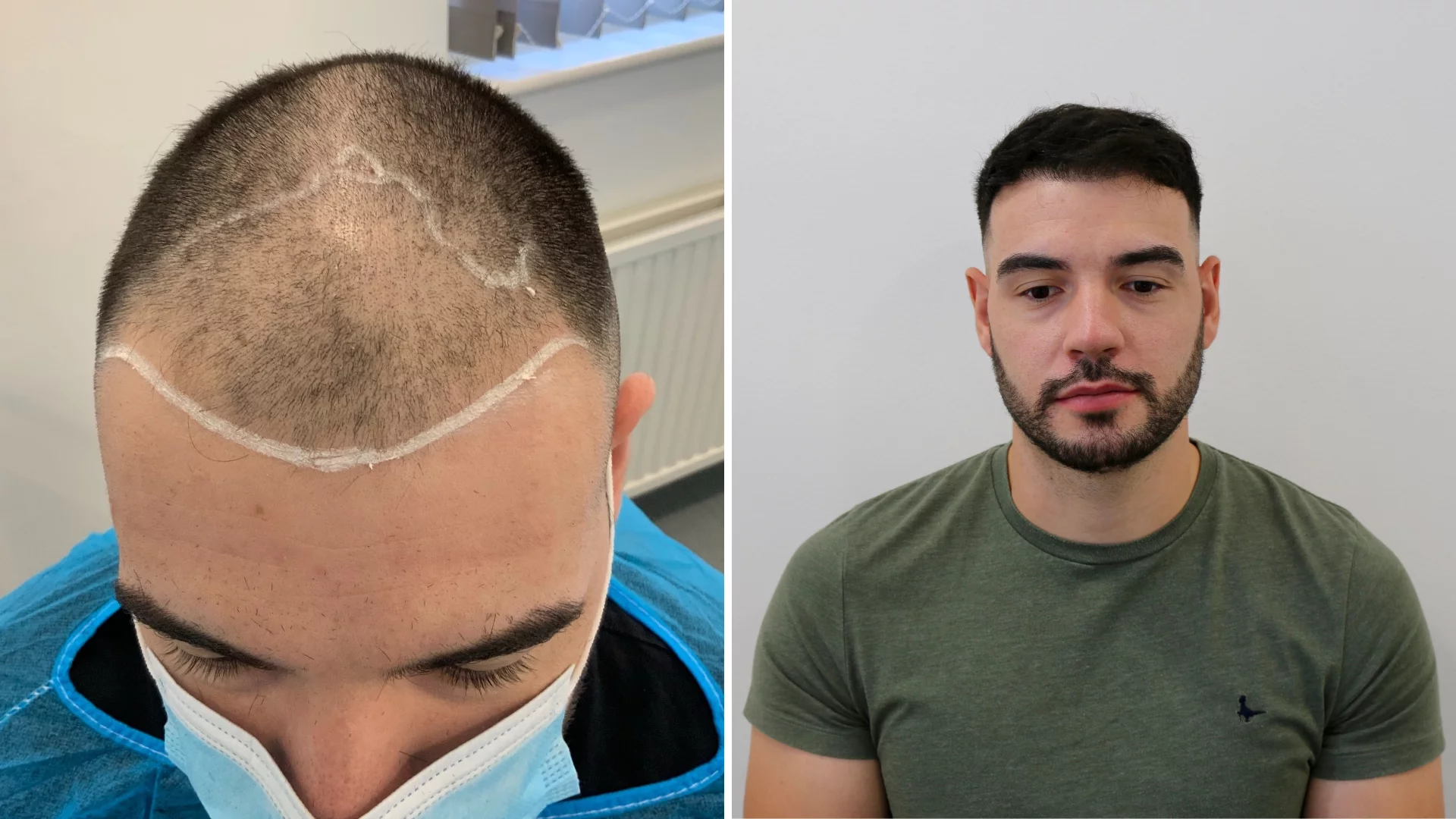
An FUE hair transplant is a minimally invasive hair restoration procedure that extracts and implants individual hairs from a donor area to balding or thinning areas.
They’re minimally invasive, one-day procedures during which qualified surgeons and technicians extract individual follicles and reimplant them in areas of hair loss to achieve a permanent, 100% natural outcome.
There are numerous benefits in terms of results, reduced recovery time, microscopic incisions and a lack of scarring in comparison to other types of hair transplant, all of which we’ll explore here to help you make informed decisions.
FUE Hair Transplants: Key Takeaways
- FUE hair transplants differ from other methods in that experienced practitioners will extract individual, specifically selected donor follicles, rather than large strips of tissue that leave stitches and scarring.
- Preparing tiny grafts not only makes a hair transplant invisible to the naked eye but also ensures that transplanted follicles match the exact characteristics, colour, and texture of natural hair growth.
- While FUE hair transplants take longer due to the exacting attention to detail required, the results are compelling, correcting receded hairlines, balding, and patchy growth with no indication that a patient has undergone a surgical procedure.
The Impacts of Follicular Unit Extraction Hair Transplant Techniques on Modern Hair Transplantation
Hair loss is far from unusual and affects as many as 6.5 million men in the UK [1] and 40% of female hair transplant clients, while a staggering 64% of patients in the UK have felt dissatisfied with NHS care. [2]
But have you noticed that hair loss treatment is becoming much more accessible and is increasingly sought after by the younger generation? This is all down to a process known as Follicular Unit Extraction (FUE).
With this minimally invasive surgery, treatment can be completed in a single day, and with a short recovery period, you can be back at work quickly.
What Is FUE Hair Transplantation?
An FUE hair transplant is a minimally invasive hair loss treatment that harvests hair from anywhere on your body by removing each root individually and transplanting it into your scalp.
Transplants are carried out follicle by follicle and in the direction of the hair growth to provide a natural-looking hairline. The follicles are chosen according to their density and inserted into the hairless parts of your scalp.
Dr Matee from KS Clinic’s Directorship team explains that ‘FUE is now used extensively by hair restoration clinicians who recognise that precision and accuracy make a profound impact on the results and satisfaction of patients.
In one day, and under pain-free local anaesthetic, practitioners can restore hairlines, eyebrows and beards at varying stages of hair loss, with permanent improvements in natural hair growth achieved in just a few months.’
What Happens During an FUE Hair Transplant Procedure?
FUE doesn’t involve synthetics or general anaesthetic, and works as follows:
- After a consultation, your clinician will advise whether an FUE transplant is the appropriate approach to restore your desired hairline.
- Should you decide to proceed, you’ll receive preparation and aftercare instructions and can then schedule your procedure for a convenient date.
- On the day, your surgery will be completed under local anaesthetic to ensure it is pain-free, on a walk-in/walk-out basis, which means you’ll be able to return to your local accommodation or home the same day.
- Over the next two weeks, rest and recovery are essential, and your surgical team will check that you’re fully versed in all you need to do to protect your newly transplanted follicles.
While FUE hair transplant results, as with any alternative technique, aren’t visible immediately, you’ll start seeing new hair growth over a few weeks, and full hair restoration within about 12 months.
Are There Famous Faces Who’ve Had FUE Hair Transplants?
Yes, there are hundreds of celebrities, sportspeople, and TV personalities who have had an FUE hair transplant to correct their hairlines, including recent patients Craig Hamilton, best known for Glow Up BBC, and Harley and Jacob Nelson from Spud Bros.
See more patient testimonials here if you’d like to see some of the life-changing results possible. You may also be interested in a testimonial from Xavier Rush about why he went through the process, what was involved, and what it’s done for him.
The Five Key Benefits of FUE Hair Transplants vs Alternatives
The table below contrasts Follicular Unit Transplantation (FUT) with FUE to provide a concise comparison.
| FUE Hair Transplants | FUT Hair Transplants | |
| Follicle extraction | Only the involved root cell is removed. | Full strips of tissue are transplanted. |
| Invasiveness | No incision or suture is required. | Leaves linear lines of stitches and subsequent scarring. |
| Permanent scarring | Minimal scarring that can only be seen through a microscope. | Scarring must be concealed beneath hair growth. |
| Flexibility | It’s possible to have follicles taken from the nape of the neck for the transfer. | Follicles can only be transplanted from strips of tissue with adequate follicular growth. |
| Applications | Hair loss treatment is not just for the head – it can also be used on eyebrows, moustaches and beards. | Primarily suited only to scalp hair restoration and for cases where visible scars will not be problematic. |
Up to 2,500 grafts can be extracted per session thanks to the quick, effective, and reliable technique, which means FUE transplants may be suitable even for more extensive hair loss, without the scarring and recovery periods associated with less precise methods.
How Can I Find Out More About FUE Hair Transplants?
If you’re interested in learning more about FUE transplants or would like to book a free consultation to discuss your hair restoration requirements, please call 0800 023 4050, request a callback below, or complete KSL Clinic’s online contact form here.
With practices located in Kent, Manchester, Birmingham, Cardiff, Newcastle and beyond, we look forward to getting you back to your best.
Get a cost for your hair transplant
Looking for a consultation regarding the hair transplant cost? Book a free consultation with us today to see what we can do for you.
FUE Hair Transplants: Frequently Asked Questions
Should I Choose an FUE or an FUT Hair Transplant?
FUT hair transplants are, in effect, skin grafts. They require stitches and permanent linear scarring and can cause tissue damage around the extraction site.
That said, an FUT transplant could be a good option if you want a quick, straightforward, non-customised procedure.
However, FUE represents a safer, no-scar alternative, where talented hair restoration surgeons can customise the results to the hair density and shape you’d like to achieve.
Data from the International Society of Hair Restoration Surgery indicates that 66% of all surgical hair restoration procedures are now FUE transplants, compared with 29.8% FUT and 4.2% a combination of the two techniques. [3]
Are there any other hair loss treatments other than FUE hair transplants?
Yes. Hair transplants are just one option. There are several non-surgical hair loss treatments that may be suitable depending on the cause, stage and pattern of hair loss.
Here are the main alternatives:
1. Medication (Clinically Approved Treatments)
- Minoxidil (topical solution or foam)
Applied directly to the scalp to stimulate hair follicles and prolong the growth phase. - Finasteride (oral medication)
Reduces DHT levels, the hormone responsible for male pattern hair loss.
These are often first-line treatments for androgenetic alopecia and can slow or stabilise hair loss. Results require ongoing use.
2. PRP (Platelet-Rich Plasma) Therapy
A non-surgical treatment where a small amount of your blood is processed, and concentrated platelets are injected into the scalp to stimulate follicles and improve thickness.
Often used:
- In early-stage hair thinning
- Alongside medication
- To support transplant results
3. Low-Level Laser Therapy (LLLT)
Uses medical-grade laser light to stimulate cellular activity in hair follicles. Available via in-clinic devices or at-home laser caps.
Best suited for:
- Mild to moderate thinning
- Patients looking for non-invasive support
4. Prescription Hormonal Treatments (for Women)
In cases of female pattern hair loss or hormone-related shedding, treatments such as anti-androgens may be prescribed under medical supervision.
5. Scalp Micropigmentation (SMP)
A cosmetic procedure that creates the appearance of hair follicles using specialised pigment. It does not restore hair but can create the illusion of density or a shaved head look.
What Is the Chance That an FUE Hair Transplant Fails?
If you schedule a procedure with an accomplished, regulated UK provider, the chance of transplant failure is very slim – and clinicians will always inspect your hair and scalp before scheduling a transplant to ensure this is viable and appropriate for you.
Should I Choose an FUE or an FUT Hair Transplant?
FUT hair transplants are, in effect, skin grafts. They require stitches and permanent linear scarring and can cause tissue damage around the extraction site.
That said, an FUT transplant could be a good option if you want a quick, straightforward, non-customised procedure.
However, FUE represents a safer, no-scar alternative, where talented hair restoration surgeons can customise the results to the hair density and shape you’d like to achieve.
Data from the International Society of Hair Restoration Surgery indicates that 66% of all surgical hair restoration procedures are now FUE transplants, compared with 29.8% FUT and 4.2% a combination of the two techniques. [3]
What Is the Chance That an FUE Hair Transplant Fails?
If you schedule a procedure with an accomplished, regulated UK provider, the chance of transplant failure is very slim – and clinicians will always inspect your hair and scalp before scheduling a transplant to ensure this is viable and appropriate for you.
Are there any other hair loss treatments other than FUE hair transplants?
Yes. Hair transplants are just one option. There are several non-surgical hair loss treatments that may be suitable depending on the cause, stage and pattern of hair loss.
Here are the main alternatives:
1. Medication (Clinically Approved Treatments)
- Minoxidil (topical solution or foam)
Applied directly to the scalp to stimulate hair follicles and prolong the growth phase. - Finasteride (oral medication)
Reduces DHT levels, the hormone responsible for male pattern hair loss.
These are often first-line treatments for androgenetic alopecia and can slow or stabilise hair loss. Results require ongoing use.
2. PRP (Platelet-Rich Plasma) Therapy
A non-surgical treatment where a small amount of your blood is processed, and concentrated platelets are injected into the scalp to stimulate follicles and improve thickness.
Often used:
- In early-stage hair thinning
- Alongside medication
- To support transplant results
3. Low-Level Laser Therapy (LLLT)
Uses medical-grade laser light to stimulate cellular activity in hair follicles. Available via in-clinic devices or at-home laser caps.
Best suited for:
- Mild to moderate thinning
- Patients looking for non-invasive support
4. Prescription Hormonal Treatments (for Women)
In cases of female pattern hair loss or hormone-related shedding, treatments such as anti-androgens may be prescribed under medical supervision.
5. Scalp Micropigmentation (SMP)
A cosmetic procedure that creates the appearance of hair follicles using specialised pigment. It does not restore hair but can create the illusion of density or a shaved head look.