

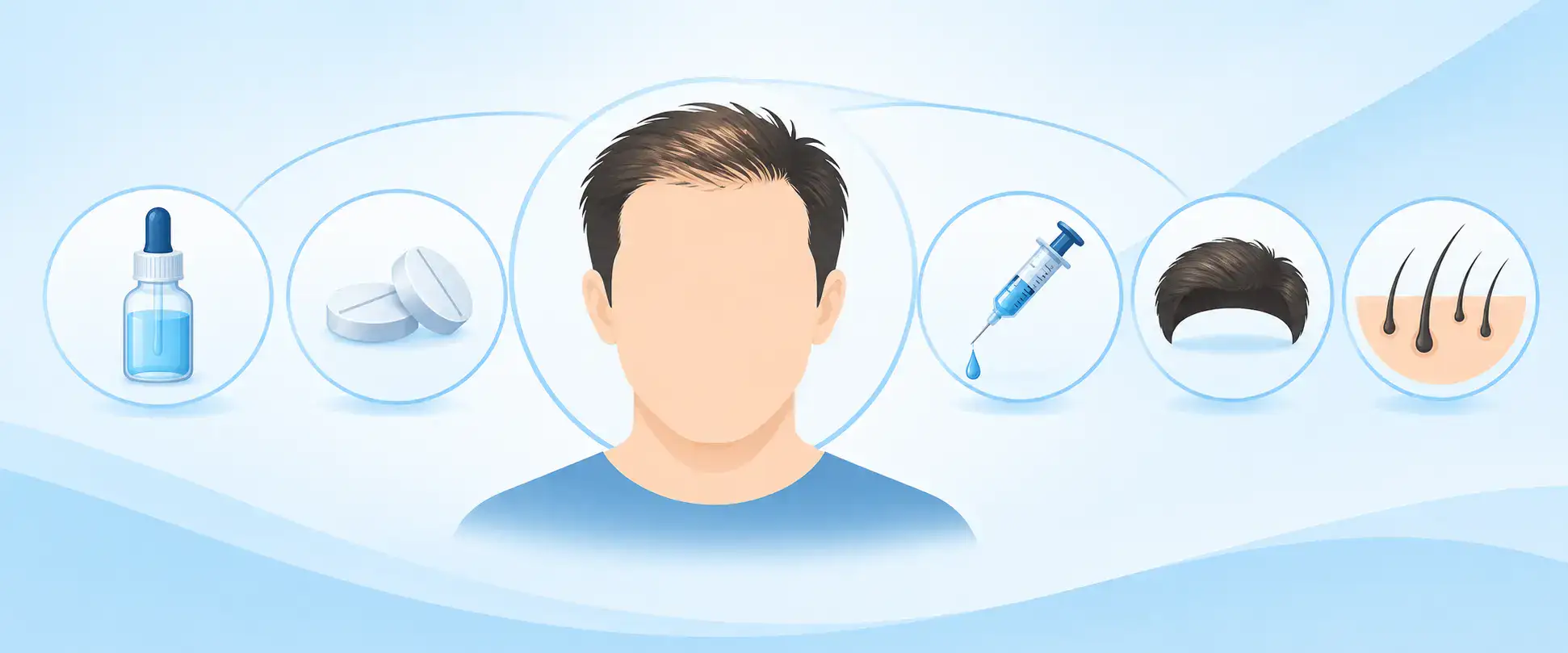
Noticing your hair becoming thinner or your hairline starting to recede can be frustrating. Naturally, you may start looking for ways to restore your hair. While a hair transplant is one option, it is not the only one worth considering. There are several hair transplant alternatives that may help, depending on the cause and extent of your hair loss.
Some treatments can slow further thinning and support existing hair growth. Others improve the appearance of your hair without actually growing new follicles.
In this article, we look into medication, PRP, hair systems and scalp micropigmentation. We also look at when an FUE hair transplant might be a more suitable option and what you can realistically expect from each approach.
Key Takeaways
- Finasteride and minoxidil can slow pattern hair loss, but they cannot guarantee regrowth.
- PRP may improve hair density in some people, although results vary.
- Hair systems provide immediate coverage without encouraging natural hair growth.
- Scalp micropigmentation makes hair look fuller but does not replace lost hair.
- Forehead reduction surgery can lower the hairline, but it cannot treat widespread thinning.
- An FUE hair transplant can restore hair to suitable areas using your own donor follicles.
Hair Transplant Alternatives Compared: Which Options Work Best?
| Treatment | Main purpose | Expected timeframe | Important consideration |
| Finasteride | Helps slow male pattern hair loss | Several months | Prescription treatment; suitability and side effects require medical assessment. |
| Minoxidil | Helps maintain or improve existing hair growth | Several months | Results generally require continued use. |
| PRP therapy | May improve hair density in some patients | Usually requires a course of treatments | Results vary and evidence is still developing. |
| Scalp micropigmentation | Creates the appearance of fuller hair | Immediate cosmetic appearance after treatment | Does not produce new hair growth. |
| Hair replacement systems | Covers thinning or bald areas | Immediate | Requires regular maintenance and replacement. |
| Forehead reduction surgery | Lowers a naturally high hairline | Recovery and results develop over time | Only suitable for selected patients; does not address general hair thinning. |
| FUE hair transplant | Moves existing follicles into areas needing coverage | Growth develops over several months | Requires suitable donor hair and a clinical assessment. |
Non-Surgical Hair Transplant Alternatives
If you’ve recently noticed more hair in your brush or a widening parting, surgery might not be your first step. Some non-surgical treatments can help protect the hair you still have, particularly when thinning is caught early.
However, it’s important to know their limits. These treatments generally work best where hair follicles are still active, rather than areas where hair has been permanently lost.
-
Medication options
Finasteride and minoxidil are two established medications for pattern hair loss. They work differently, but both may help maintain existing hair.
- Finasteride is usually taken as a daily tablet. It reduces DHT, the hormone responsible for gradually shrinking susceptible hair follicles in male pattern hair loss. For some men, this means less shedding and even some regrowth. A doctor will need to assess whether it’s suitable for you.
- Minoxidil works differently. Applied directly to the scalp, it can encourage growth in areas where hair is thinning. Some people notice extra shedding when they first start using it, which can be unsettling. This is usually temporary, but visible improvement can take several months.
Neither medication is a permanent cure. The NHS guidance on hair loss treatments explains that these treatments do not work for everyone and only remain effective while being used.
For a closer comparison, read our guide to finasteride and minoxidil compared.
-
PRP
PRP, or platelet-rich plasma, takes a different approach. A small amount of blood is collected and processed to concentrate the platelets. This plasma is then injected into thinning areas of the scalp.
The aim is to support existing follicles using growth factors released by the platelets. Research has shown some encouraging results, particularly for people with pattern hair loss, but the evidence isn’t conclusive yet.
PRP is also unlikely to help much in areas where follicles have been permanently lost. Several appointments may be needed, and not everyone sees a noticeable change.
Before booking, it’s worth finding out whether PRP is worth it for your particular type of hair loss.
Hair Replacement Systems And Scalp Micropigmentation As Transplant Alternatives
Not every solution needs to encourage new hair growth. If your main concern is how your hair looks today, there are ways to create fuller-looking coverage without surgery.
-
Micropigmentation
Scalp micropigmentation uses tiny deposits of pigment to imitate the appearance of hair follicles. It’s often used to create a closely shaved look or make thinning areas appear less obvious.
The result is visual rather than physical. You won’t have more hair to run your fingers through, and the pigment may need refreshing as it fades.
KSL Clinic does not offer scalp micropigmentation.
-
Hair system
A hair replacement system is a covering made with natural or synthetic hair. It’s fitted to the scalp and can conceal significant hair loss without surgery. The colour and texture can also be matched to your existing hair for a more natural appearance.
One obvious benefit is the immediate change. You don’t have to wait for hair to grow, and you can choose a style that feels like you.
The trade-off is maintenance. Hair systems need regular cleaning and refitting, and they may eventually need replacing. Your natural hair can also continue thinning underneath.
Not sure which treatment is right for you? Book a consultation with KSL Clinic to discuss your hair loss and find out which options may work best for you.
Free consultation
Looking for a consultation regarding your hair transplant fall out? Book a free consultation with us today to see what we can do for you.
Surgical Alternatives To Hair Transplants: Forehead Reduction Surgery
Forehead reduction surgery, sometimes called hairline lowering surgery, is another hair transplant alternative worth understanding. Rather than moving individual follicles, the surgeon removes a section of forehead skin and brings the existing hairline forward.
It may suit someone with a naturally high forehead and sufficient scalp flexibility. However, it doesn’t improve thinning across the scalp or address ongoing pattern hair loss.
An FUE hair transplant works differently. Individual follicles are taken from a donor area and placed where more coverage is needed, allowing the surgeon to address specific areas of hair loss.
If you’re unsure which approach makes sense for your hair, a consultation at KSL Clinic can help you understand your options. There’s no need to decide on surgery before you’ve had a proper assessment.
What a KSL Clinic Surgeon Says About Alternatives To Hair Transplants
“It’s easy to focus on getting your hair back, but the first question should always be why you’re losing it. If the follicles are still active, non-surgical treatments may help. When significant hair loss has already occurred, it’s worth discussing whether a transplant could give you the coverage you’re looking for.”
Deciding Between Hair Transplant Alternatives And Surgery
There’s no single treatment that works for every type of hair loss. Understanding the main reasons for hair loss is a sensible place to start, particularly if you’ve only recently noticed changes.
Hair transplant alternatives can help slow thinning or make hair loss less visible. But they cannot fully reproduce what a transplant does by moving healthy follicles into areas that need coverage.
An FUE hair transplant may provide more substantial restoration, although your donor hair and pattern of hair loss will influence what’s possible. If you’re considering your next step, book a consultation with KSL Clinic to find out whether you are a good candidate for a hair transplant.
- Hair density: what does it mean? Understand what affects the fullness of your hair.
- Receding vs mature hairline Learn how to recognise changes in your hairline.
- Male pattern hair loss Find out why male pattern hair loss develops.
Frequently Asked Questions About Transplant Alternatives
Choosing a treatment can raise plenty of questions, especially when the results aren’t guaranteed. Here are answers to some common concerns.
What is the best hair transplant alternative?
That depends on the condition of your hair and what you want to change. Medication may be useful if thinning has only recently started, while a hair system can cover more advanced hair loss straight away.
Cost and ongoing maintenance matter too. A treatment that works well for one person might not suit someone else’s needs.
Are there side effects to non-surgical hair loss treatments?
Yes. Finasteride can cause sexual side effects and changes in mood. The MHRA has warned that some sexual side effects may continue after treatment stops.
Topical minoxidil may cause scalp irritation or unwanted hair growth elsewhere. PRP injections can cause temporary tenderness and swelling, as discussed in a 2024 systematic review.
How effective is PRP for hair loss?
A 2024 systematic review involving 431 participants across 14 studies found that PRP may improve hair density in people with pattern hair loss. But the researchers also noted weaknesses in the available evidence.
That means PRP shows promise, but the results are difficult to predict. It shouldn’t be viewed as a guaranteed way to restore lost hair.
What is the best hair transplant alternative?
That depends on the condition of your hair and what you want to change. Medication may be useful if thinning has only recently started, while a hair system can cover more advanced hair loss straight away.
Cost and ongoing maintenance matter too. A treatment that works well for one person might not suit someone else’s needs.
How effective is PRP for hair loss?
A 2024 systematic review involving 431 participants across 14 studies found that PRP may improve hair density in people with pattern hair loss. But the researchers also noted weaknesses in the available evidence.
That means PRP shows promise, but the results are difficult to predict. It shouldn’t be viewed as a guaranteed way to restore lost hair.
Are there side effects to non-surgical hair loss treatments?
Yes. Finasteride can cause sexual side effects and changes in mood. The MHRA has warned that some sexual side effects may continue after treatment stops.
Topical minoxidil may cause scalp irritation or unwanted hair growth elsewhere. PRP injections can cause temporary tenderness and swelling, as discussed in a 2024 systematic review.
References and Sources:
- Hair loss – NHS.
- PRP and hair density: systematic review and meta-analysis (2024) – Anais Brasileiros de Dermatologia.
- Finasteride and dutasteride: updated safety warnings (2026) – MHRA.
- Minoxidil – Gloucestershire Hospitals NHS Foundation Trust.
- PRP for female hair loss: systematic review (2024) – Journal of Cosmetic Dermatology.