

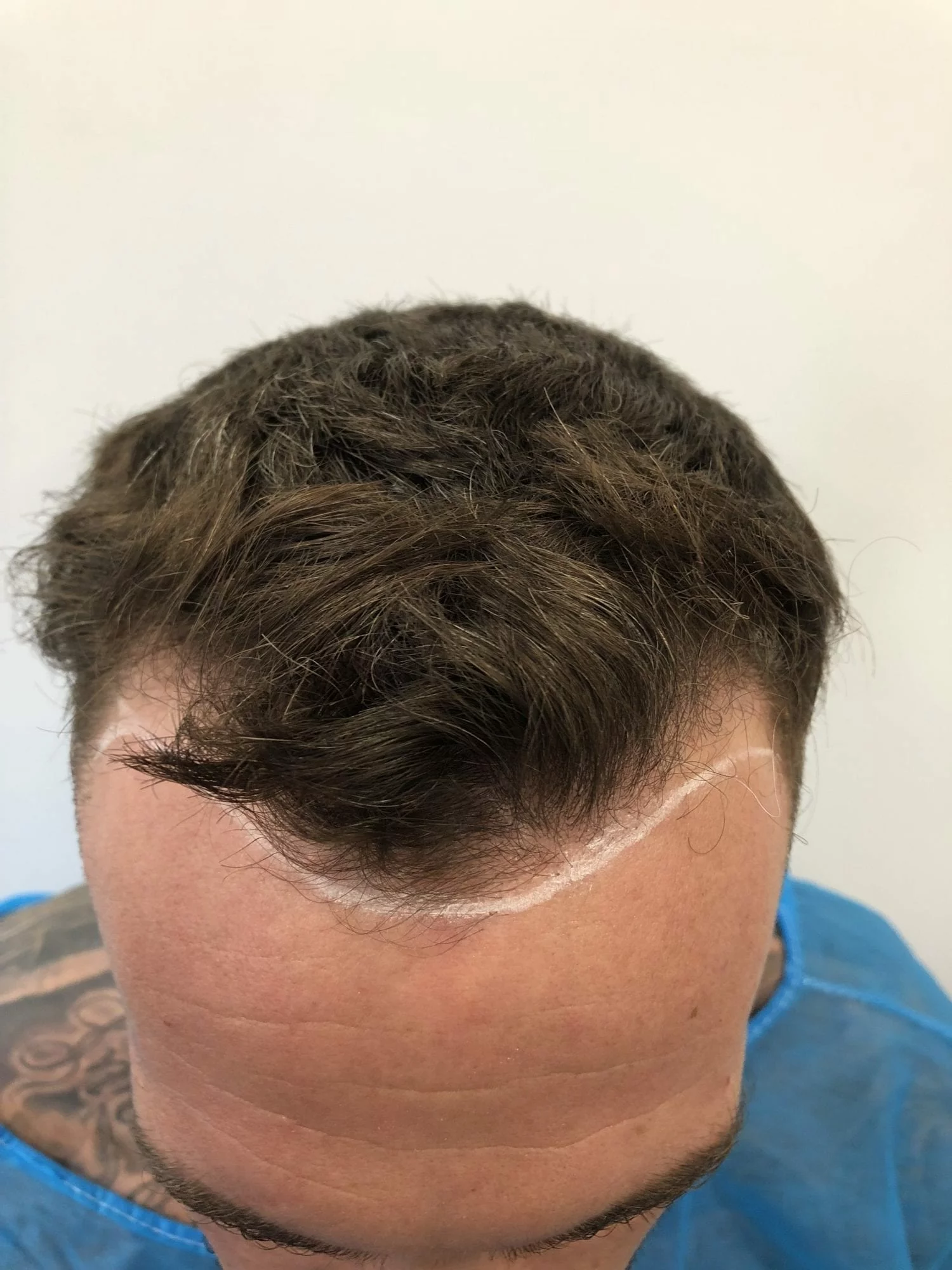
Juvenile hairlines are often regarded as highly desirable! A juvenile hairline is the natural hairline that a person has during childhood and early adolescence, typically before the age of 17.
Teens tend to have a hairline that hair restoration professionals characterise as a full head of hair with rounded, smooth edges, a low position on the forehead and a fairly straight hairline across the temples
One of the major contrasts between a juvenile and a mature hairline is the point at which the hair growth appears on the forehead, with a juvenile hairline being a shorter distance from the eyebrows.
Over time, and depending on factors like genetics, a juvenile hairline will generally start to recede, which can cause changes to both its shape and its position on the forehead. Mature hairlines often replicate an M shape or W shape, creating a widow’s peak.
Facts About Juvenile Hairlines
- Juvenile hairlines are lower on the forehead and have more rounded edges instead of the M or W shape we associate with a mature hairline.
- Most people have a juvenile hairline by around age 18, but this can vary between people. The movement of the hairline upward from that point onward is normal and an indication of maturity rather than a sign of baldness or hair loss.
- One of the easiest ways to see whether you have a juvenile hairline is to raise your eyebrows while looking in a mirror. When your hairline touches the highest line or wrinkle on your forehead, you’ve likely got a juvenile hairline.
How Are Juvenile and Mature Hairlines Different?
For most patients, mature hairlines are about two or three cm higher on the forehead than a juvenile hairline, and in relation to the wrinkle or line that appears highest on your forehead when you raise your eyebrows.
A hairline may require a hair restoration treatment when it continues past this point or recedes further, signifying a potentially balding hairline.
That doesn’t mean a hair transplant or alternative procedure isn’t suitable for patients with hair loss concerns or areas of thinning, even if they continue to maintain a lower hairline on the face.
However, there is a distinction between a juvenile and mature hairline, which can affect the suitability of a hair transplant or the point at which KSL Clinic’s accomplished hair restoration professionals might consider a transplant a good option.

Is it Possible to Have a Hair Transplant to Correct a Juvenile Hairline?
As we’ve indicated, juvenile hairlines are typically seen as the best potential hairline, which means we don’t often consult with patients under the age of roughly 23. In contrast, it’s also very possible to work with patients who have long been dissatisfied with their natural hairline.
Over recent years, interest in permanent hair transplants has soared among younger patient groups, including those who have seen dramatic declines in hair density or those who are experiencing early-stage hair loss that impacts their self-esteem.
Age isn’t the only relevant factor when deciding whether a hair transplant is appropriate, but as a quick guide:
- There are no universal age limitations on hair transplants, and there is no age at which a hair transplant would be most successful for every patient.
- Timings are key. Hair transplants should be scheduled before a hairline recedes to the point at which there are insufficient viable donor follicles, but without intervening too early, when hair loss is very likely to progress.
- Most patients are at least 30 or old, but this is a typical guideline, and much depends on the pattern and pace of hair loss rather than age.
It’s also very important to control hair loss or thinning to optimise the results of a hair transplant. Thus, a patient with initial thinning that impacts a juvenile hairline could be advised to consider a non-surgical alternative until we believe a hair transplant would be most successful.
Get a cost for your hair transplant
Looking for a consultation regarding the hair transplant cost? Book a free consultation with us today to see what we can do for you.
What Is the Difference Between a Maturing and a Receding Hairline?
Receding and maturing hairlines are two different things. Receding hairlines are incredibly common and usually down to male pattern baldness or androgenetic alopecia in male patients. While there isn’t a decisive cure for this type of hair loss, it’s also treatable with a bespoke hair transplant.
Maturing hairlines are equally natural and associated with ageing. Most patients see a higher hairline as they get older, reversing the lower hairline and thicker hair growth we refer to as a juvenile hairline.
It could also mean the hairline becomes a little higher in the temples and has less definition without those rounded edges that denote a juvenile hairline.
The difference is that mature hairlines aren’t actively receding and can be left as-is unless you’re unhappy with the appearance of your hair or would like to restore your hairline to mimic the fullness and density you had when you had a juvenile hairline.
However, hair restoration treatments and therapies, from non-surgical interventions to customised hair transplants, are often recommended for patients with receding hairlines at various stages.
Why Do Hair Transplant Specialists Advise Against a Hair Transplant for Younger Patients?
Every recommendation we make is subject to an in-person, private, and confidential consultation. During this appointment, we’ll discuss your hair loss issues, concerns, and wishes and conduct a clinical assessment of your scalp.
That’s because although hair transplants aren’t always recommended for younger patients, a lot will also depend on how your hairline or growth is changing and how dramatically this is impacting your confidence or appearance.
Hair loss and hairline maturity in younger men can occur fairly quickly and unpredictably, which can, in many cases, cause concern or mean your appearance alters considerably over a short space of time.
Our advice is based on an appraisal of the reasons for hair loss and on whether you would prefer to undergo an earlier-stage hair transplant with the expectation of further interventions in the future or would rather allow hairline maturity to progress until the point at which a hair transplant is usually advisable.
In any scenario, whether you have a juvenile hairline you dislike, have seen changes to your hair growth, or want to assess the suitability of a juvenile hair transplant, we suggest booking a cost-free consultation with your nearest KSL Clinic to discuss the options.