
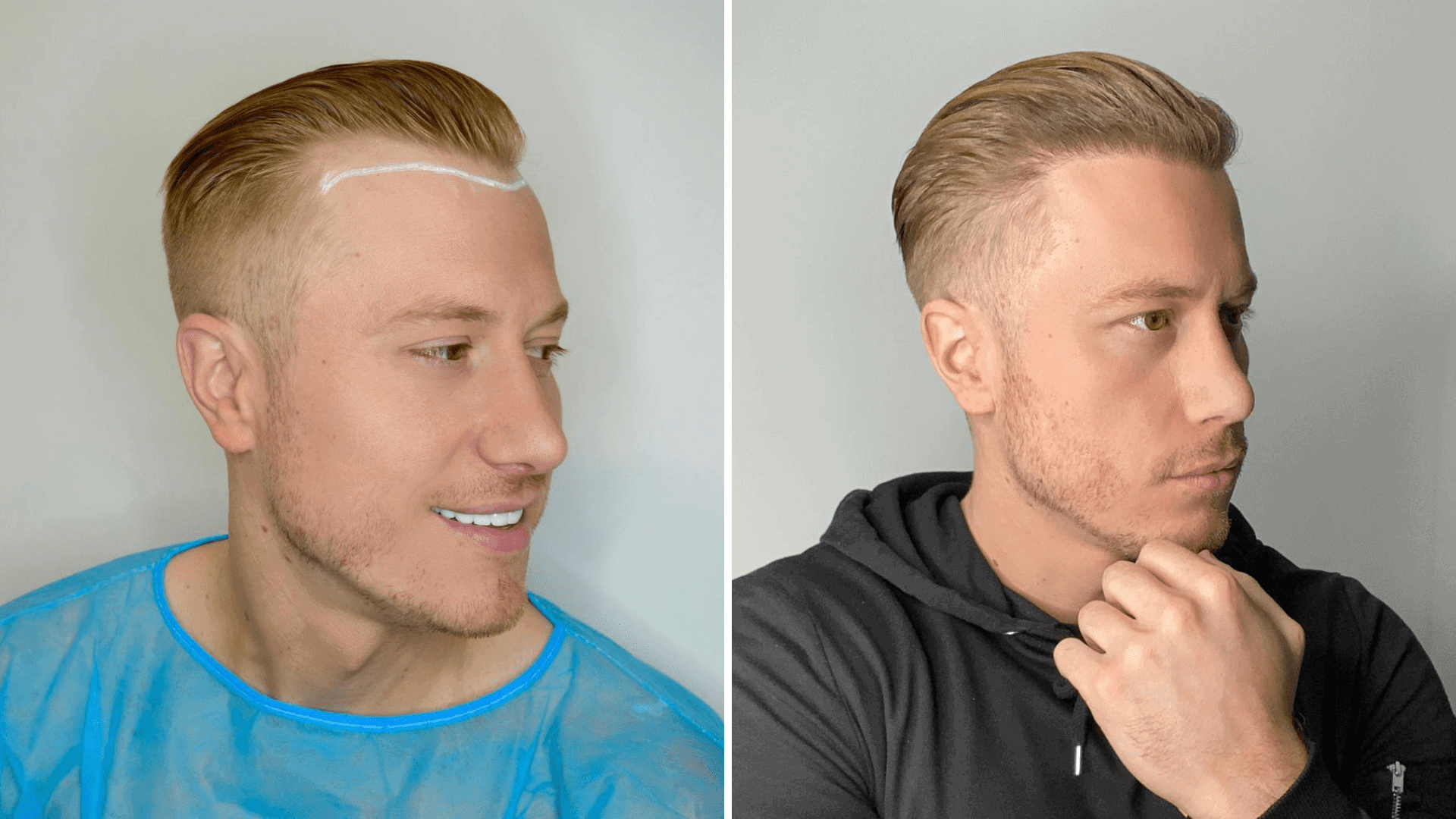
So you’ve had your FUE hair transplant. Congratulations! Now what? When it comes to getting a hair transplant, it is important to recognise that the results are going to change and improve over time. Unfortunately, it’s not as simple as undergoing the procedure and then having a full set of hair. You need to give your scalp time to heal and for new hair to develop and grow. Let’s take a look at the results of a hair transplant week by week and month by month to give you a better understanding of what to expect after your transplant.
Summary
- It takes between 12 and 20 months to see the full results from a hair transplant
- The first 14 days are the most crucial for helping your grafts build strength for regrowth
- It is very important to follow the post-operative care instructions for the best long-term results
Watch Dr Erjon explain a typical hair transplant timeline:
A Full Hair Transplant Timeline:
The first 14 days after your transplant
The first two weeks are detailed in your provided post-operation instructions. It is important to make sure you avoid physically touching your hair for the first 14 days.
Sleeping elevated for 5 nights with the provided neck pillow is important, and we understand this unfortunately may not be your natural sleeping position, but again this ensures you do not accidentally touch your hair for the first 5 days, after which, you will then start your post-op hair washing procedure.
Your doctor will advise you on this and the products to use. Once you reach the seven to ten day mark, the transplanted grafts are going to build strength, which means they are not going to fall when touched, however, do be mindful and don’t start scratching your head!
It is at the seven-day mark you may wear a loose-fitted cap, but only if you really have to (not advised).
A power shower, and any strenuous physical activity or exercise are prohibited in the 14 day period.
Read more:
Days 15 – 30 – two weeks to 1 month after your hair transplant
In around two to three weeks, your scalp will have regained its previous appearance, with the initial redness, and scabbing having subsided, this is why a lot of our patients like to take two weeks off work after their hair transplant and then return around this stage. Don’t worry if you have experienced some hair shedding at this point, completely normal.
1 to 3 months after hair transplant
Around this period, you will start to see further shedding of the implanted hairs, it’s perfectly normal to be concerned but there is nothing to worry about.
It is a natural part of the process but we know it can cause panic, especially if you are not expecting it.
This is why it is so important to learn all about the different hair growth stages so that you’re fully prepared and know what to expect. You may start to see some new hair growth around the 3-month mark, which will continue from here on.
3 to 6 months after hair transplant
You will notice that the rate of re-growth starts to increase from the third or fourth month. Half of the result may be seen from the sixth month. The results you dreamed of are starting to take shape!
Read more: What to expect 4 months after a hair transplant
6 to 12 months after hair transplant
This is another exciting period, as during these six months the hair is going to grow and grow, becoming thicker and stronger with each passing month.
After 12 months, you are advised to arrange a review of the implant area and the overall result of the procedure, although end results can take up to 18 months to fully show. Throughout the year, it is possible to request a review, so get in touch as and when you need to.
12 – 18 months after hair transplant
This is the final stage of hair growth, and when you can expect to see the final results of the hair transplant operation come to fruition. Your hair is going to look thicker, longer, and more intense.
The final result will appear in the front area around 12 – 15 months after the operation. For the crown, you can expect full restoration after 18 – 20 months.
So there you have it: the different hair transplant growth stages. Hopefully, this hair transplant progress timeline has helped to give you a better understanding of what you should expect if you do decide to undergo an FUE hair transplant.
If you’re thinking about getting a hair transplant in the UK, get in contact with us today and find out about the process and how much it’ll cost. Looking to speak to our hair transplant specialists about hair transplant timelines? Get in touch with KSL Clinic today.
Real Life Hair Transplant Timelines from a KSL Clinic Patient: From Week 1 to 39
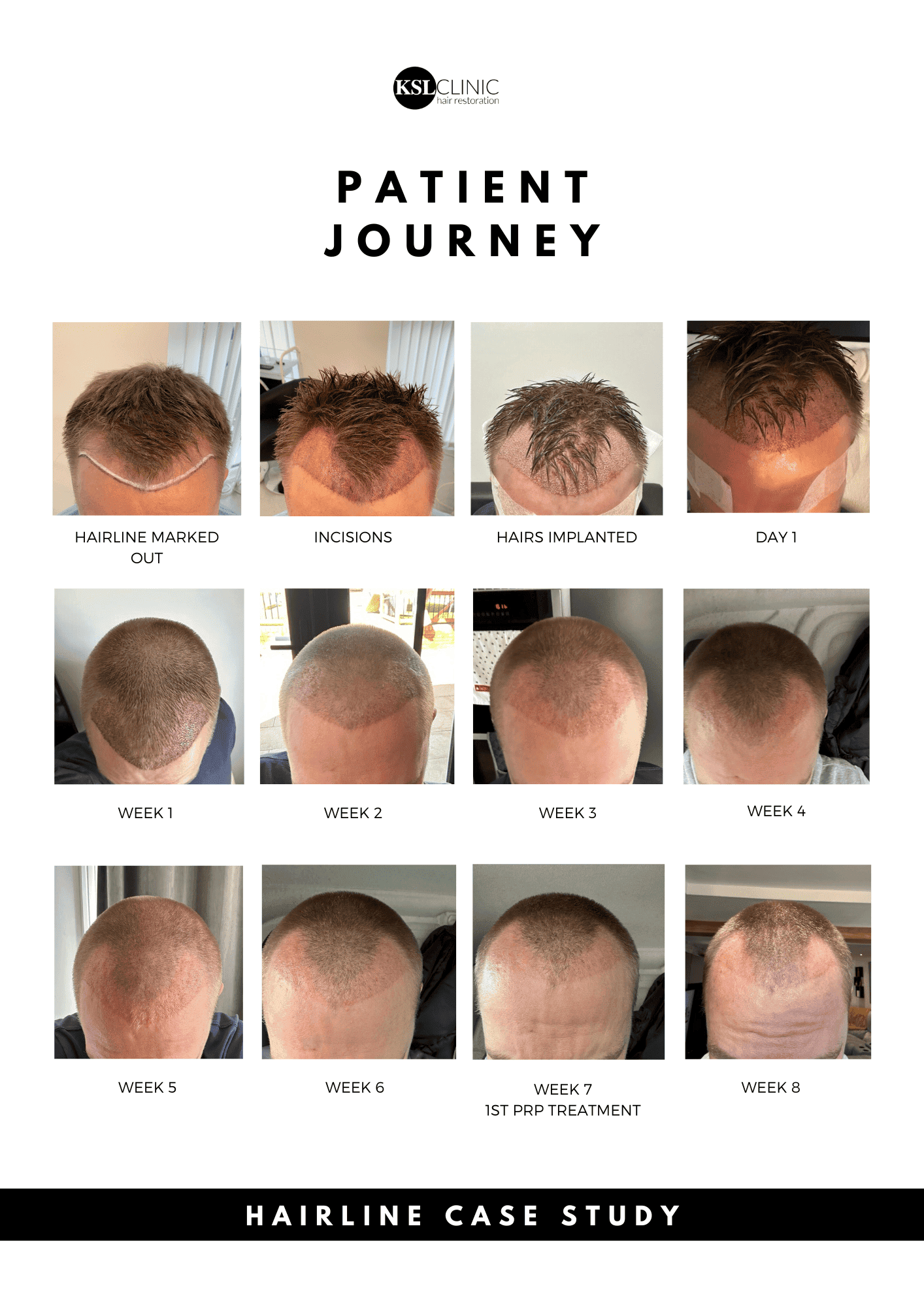
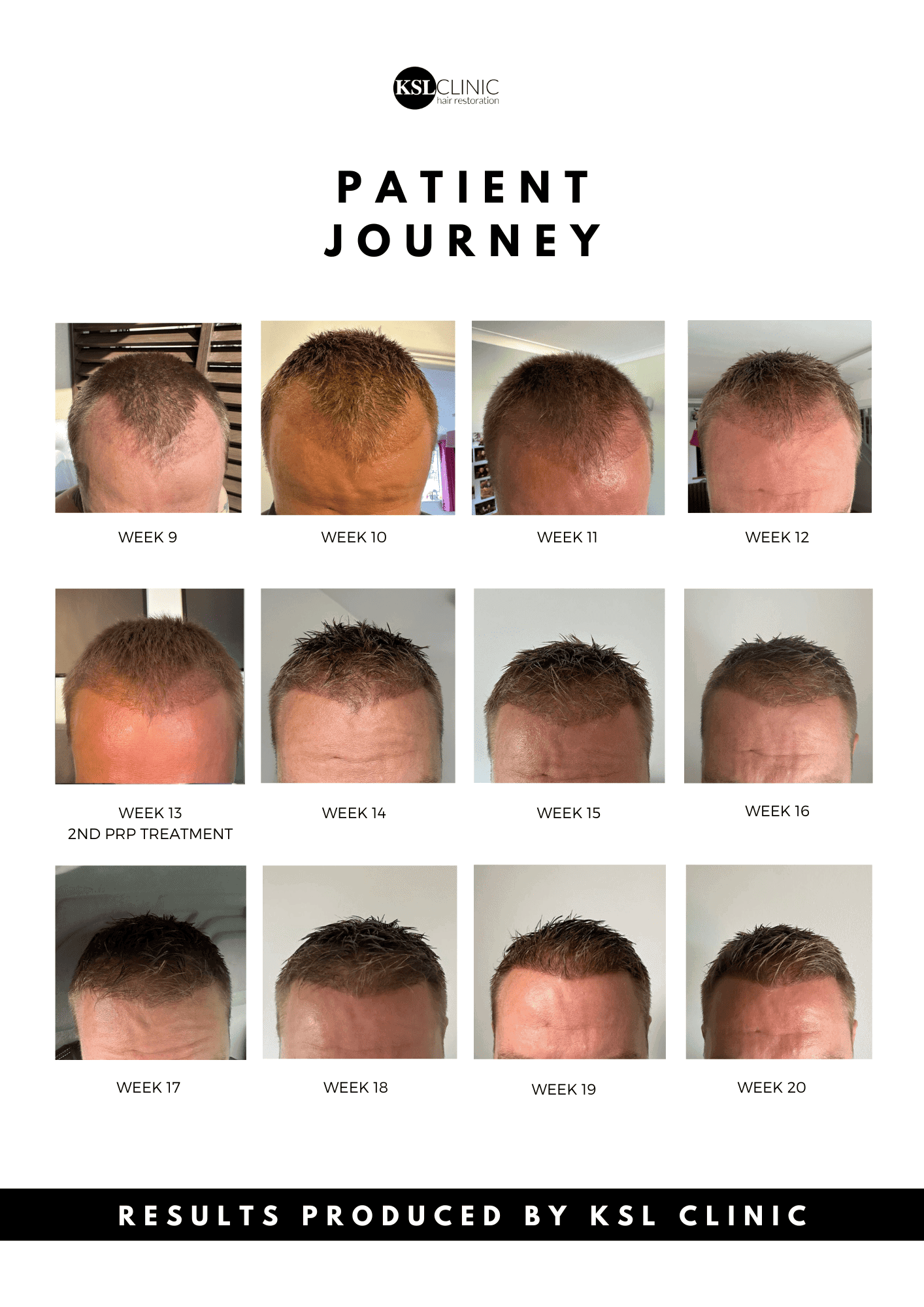
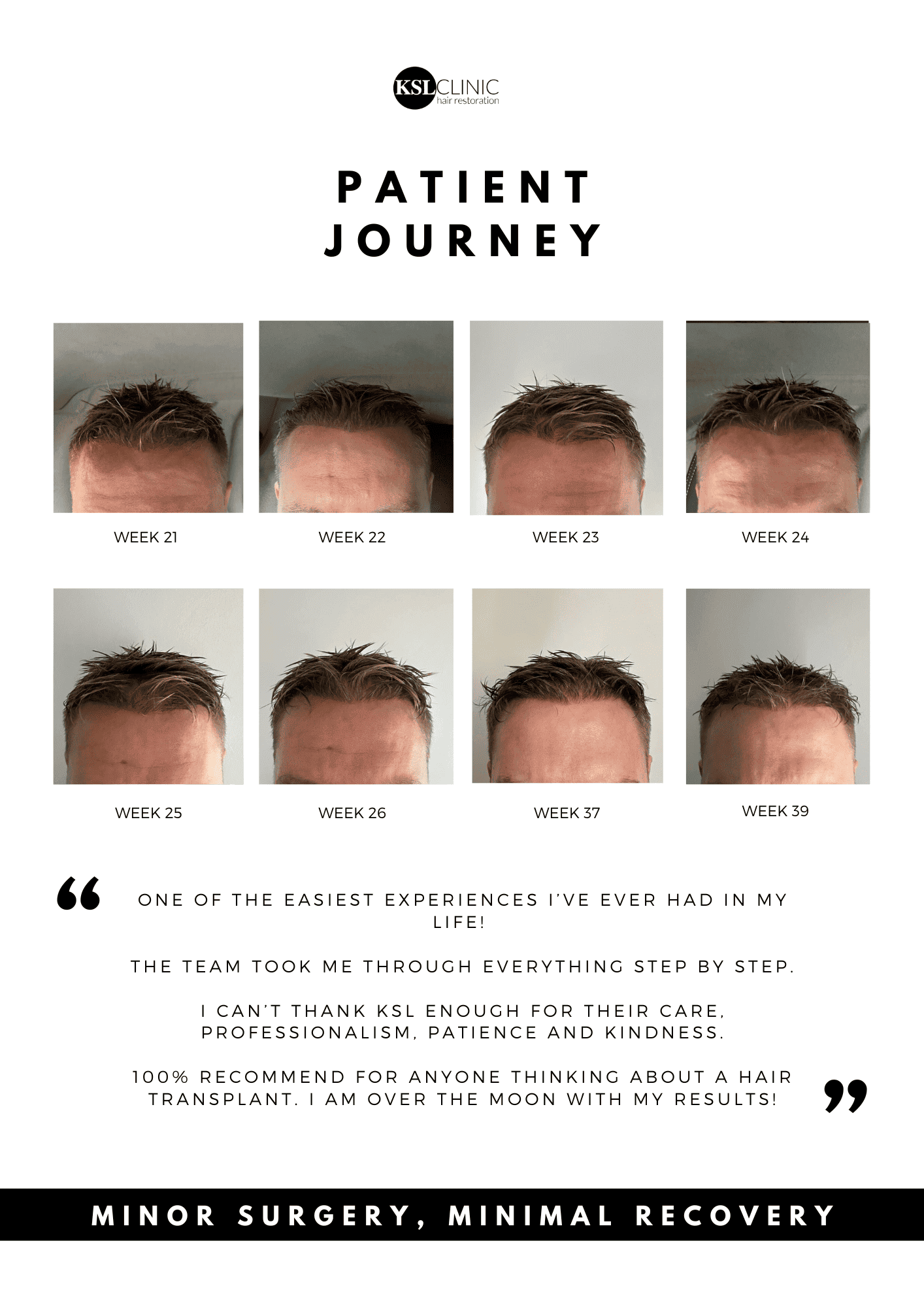
Hair Transplant Timeline Summary (By Weeks) from transplant to full maturation time
| Week(s) | What’s Happening | What to Expect / Key Advice |
| Weeks 0–2 | Critical healing phase | Grafts begin to anchor and strengthen. Avoid touching the scalp, strenuous exercise, and power showers. Sleep elevated for the first 5 nights. Follow post-op washing instructions carefully |
| Week 1 | Early graft stabilisation | Grafts become more secure. Avoid scratching. A loose-fitting cap may be worn if necessary |
| Weeks 2–4 | Scalp recovery | Redness and scabbing fade. Scalp starts to look more normal. Temporary shedding is common and expected |
| Weeks 4–8 | Shedding phase | Transplanted hairs shed as part of the natural hair growth cycle. This is normal and temporary |
| Weeks 8–12 | Transition phase | Shedding slows. Early signs of new hair growth may start to appear toward the end of this period |
| Weeks 12–16 | Early regrowth | New hairs begin to grow and become noticeable |
| Weeks 16–24 | Accelerated regrowth | Hair growth rate increases. Around 50% of the final result may be visible by the end of this stage |
| Weeks 24–36 | Thickening phase | Hair becomes denser, stronger, and more consistent |
| Weeks 36–52 | Maturation phase | Continued growth and thickening. Overall shape and coverage improve significantly |
| Weeks 52–72 | Final result develops | Front hairline typically matures first. Crown area continues improving |
| Weeks 72–80 | Crown completion | Full crown results usually visible, completing the transplant outcome |
The Hair Regrowth Cycle Explained
Understanding the hair regrowth cycle is key to setting realistic expectations after a hair transplant. Hair does not grow continuously. Instead, it follows a natural cycle made up of four distinct stages.
Anagen (growth phase)
This is the active growth phase, where hair follicles produce new hair. On the scalp, this phase can last several years. Following a hair transplant, newly implanted follicles will eventually re-enter the anagen phase, which is when visible regrowth begins.
Catagen (transition phase)
A short phase where hair growth slows and the follicle detaches from the blood supply. This stage lasts only a few weeks and is a normal part of the cycle.
Telogen (resting phase)
During this phase, hair stops growing but remains in place. Many transplanted hairs enter telogen shortly after surgery, which explains the common post-transplant shedding.
Exogen (shedding phase)
The final stage, where old hairs are shed to make way for new growth. While this can feel alarming after a transplant, it is entirely normal and temporary.
Following an FUE hair transplant, follicles reset and gradually move back into the growth phase. This is why results take time and why patience is essential.
Factors That Can Influence Post Hair Transplant Growth
Hair transplant results are highly individual. Several factors can influence how quickly and effectively transplanted hair grows.
Genetics
Your natural hair characteristics, such as density, curl, thickness and growth speed, play a significant role in your final result.
Blood supply and scalp health
Good circulation supports follicle nourishment and growth. A healthy scalp environment encourages stronger regrowth.
Age and general health
Younger patients and those in good overall health often experience faster healing and more predictable growth patterns.
Lifestyle factors
Smoking, excessive alcohol consumption, poor diet and high stress levels can negatively impact hair growth and recovery.
Post-operative care
Strictly following your surgeon’s aftercare instructions is one of the most important factors for long-term success.
How Can You Stimulate Faster Growth Post Hair Transplant?
While you cannot rush biology, you can support optimal growth conditions.
Follow aftercare guidance closely
This includes washing routines, sleeping positions and activity restrictions during the early healing phase.
Maintain a balanced diet
Nutrients such as protein, iron, zinc, biotin and vitamins A, C and D support healthy hair growth.
Avoid smoking and limit alcohol
Both reduce blood flow to the scalp and can slow healing and regrowth.
Use recommended treatments only
If advised by your surgeon, treatments such as PRP or prescribed medications may help support hair growth.
Be patient and consistent
Hair regrowth is gradual. Avoid comparing your progress to others and focus on long-term outcomes rather than early milestones.
Post Hair Transplant Growth Myths
Myth: Hair should start growing immediately
In reality, most growth begins between three and six months after surgery.
Myth: Shedding means the transplant has failed
Post-transplant shedding is a normal part of the regrowth cycle and does not affect final results.
Myth: All hairs grow at the same speed
Hair grows in cycles, so uneven early growth is completely normal.
Myth: You can speed up results with aggressive treatments
Overusing products or treatments can irritate the scalp and potentially delay healing.
Frequently Asked Questions
How long until a hair transplant looks normal?
The timeline for when a hair transplant appears normal varies from person to person. Typically, within the first two weeks, initial redness and scabbing start to diminish, allowing your scalp to regain a more natural appearance. However, it may take several months for the transplanted hair to fully blend in with your existing hair and for any signs of the procedure to become virtually undetectable.
How can I maximise hair growth after my FUE hair transplant?
To maximise hair growth, follow your surgeon’s post-operative care instructions meticulously. This includes avoiding smoking and alcohol, maintaining a healthy diet rich in vitamins and minerals, and using any recommended products and supplements to support new growth.
Will the texture of my transplanted hair change over time?
Transplanted hair may initially grow finer or curlier than your natural hair. Over time, usually within six to twelve months, the texture will often normalise and blend seamlessly with the surrounding hair, providing a more uniform appearance.
How strong are hair grafts after 7 days?
After 7 days, hair grafts begin to establish themselves more securely in the scalp. While they may not be fully anchored at this point, they should be stable enough to withstand minimal contact without dislodging. It’s essential to continue following post-operative care instructions provided by your surgeon to support the healing process and ensure the long-term success of your transplant.
Is it normal to experience itching during the hair growth stages?
Yes, mild itching is common as the scalp heals and new hair starts to grow. It’s important to resist scratching to avoid damaging the transplanted follicles. Using the saline solution spray provided along with antihistamines can help subside the itching.
How long until a hair transplant looks normal?
The timeline for when a hair transplant appears normal varies from person to person. Typically, within the first two weeks, initial redness and scabbing start to diminish, allowing your scalp to regain a more natural appearance. However, it may take several months for the transplanted hair to fully blend in with your existing hair and for any signs of the procedure to become virtually undetectable.
How strong are hair grafts after 7 days?
After 7 days, hair grafts begin to establish themselves more securely in the scalp. While they may not be fully anchored at this point, they should be stable enough to withstand minimal contact without dislodging. It’s essential to continue following post-operative care instructions provided by your surgeon to support the healing process and ensure the long-term success of your transplant.
How can I maximise hair growth after my FUE hair transplant?
To maximise hair growth, follow your surgeon’s post-operative care instructions meticulously. This includes avoiding smoking and alcohol, maintaining a healthy diet rich in vitamins and minerals, and using any recommended products and supplements to support new growth.
Is it normal to experience itching during the hair growth stages?
Yes, mild itching is common as the scalp heals and new hair starts to grow. It’s important to resist scratching to avoid damaging the transplanted follicles. Using the saline solution spray provided along with antihistamines can help subside the itching.
Will the texture of my transplanted hair change over time?
Transplanted hair may initially grow finer or curlier than your natural hair. Over time, usually within six to twelve months, the texture will often normalise and blend seamlessly with the surrounding hair, providing a more uniform appearance.